Record of Locations
The locations information allows that the automatic processes be run, respecting the tables of holidays of the company.
For the execution of automatic processes, only the location code and the range of the Holiday table will be used. The further information will be the Replica application use (the use of this information will be better detailed in the sequence of this document).
As it can be noticed, the locations information has the range of holidays. The table of holidays that must be considered for the processes present in this location must be registered for this field. The reason for the presence of this field is very simple.
Imagine that you have registered an automatic process for reading of clocking events, which can be carried out only in workdays. Thus, the Scheduler application will check, before carrying out the process, if the current day is not a workday (Saturday, Sunday or the holidays registered on the System database of the Human Capital Management | HCM). Then, as the Scheduler checks if the current day is a holiday, the range of holidays reported in the locations information will be taken into consideration.
The range information is useful for companies that have a centralized database and several tables of holidays registered. It means that for a certain location it may be holiday, but not to other location, fact that will be taken into consideration by the Scheduler before carrying out the automatic process. If there is no range defined for the tables of holidays, all registered holidays will be taken into consideration.
However, for this functionality be applied by the Scheduler, it is required that the automatic process refers the location that has the range of holidays.
The indication of the location is not mandatory for the automatic processes registration, being that, if it is not reported, the checking of workday will consider all holidays registered on the database. The same idea may be applied relating to the division of processes per locations. Due to these features, it is important that all processes have their locations defined in case of the client has a formation similar to the example or it decides to use the registration of locations.
The application of location information for automatic processes is extended till this point. However, the locations have a great importance when the client has replication of data with a centralized corporate database, as follows:
LOCATIONS INFORMATION (Data Replication)
The Locations Information has crucial importance for adequate configuration of the data replication process. The data flow to be replicated for units that are part of the replication net, may be configured through these Locations. The units that will receive workers or workers from other units may be defined, or the distribution of information may be limited.
To allow these additional configurations, the Replica application uses other information from the window for locations information.
The server code will be used to inform to the replica application which will be the server that will have information from the specific location. Thus, when the configurations are carried out and the replication has been started, the data will be sent to the destined servers (usually, each server has a database prepared to receive data sent by replication).
The grid with companies information will be used only by Replication and it indicates which companies/branches are in a given location. For the purpose of understanding, it may consider that a location is a company's physical unit (building). For example, in the headquarter building are the company 1 and the branch 1. Thus, the Location Matrix comprises this group of companies. For other location, for example, may there be more than one company or branch registered. Theoretically, the location term may assume any function, from the representation of physical space as the representation of the company org. chart . The whole definition will depend on user's usage intent including the registration.
Usually, it will be required as locations as registered data servers, because all information pertinent to a certain unit (location) will be present in this server. However, nothing will prevent the user to carry out a differentiated configuration for the same server, by registering more than one location for it with different companies/branches, in order to change the information flow used by these companies.
To exemplify the use of the location information in the Replica application, the following locations information will be used:
| Location | Description | Server |
| 1 | Matrix Location | 1 |
| 2 | Branch Location 2 / 1 | 2 |
| 3 | Branch Location 1 / 2 | 3 |
| 4 | Branch Location 1 / 5555 | 4 |
For each location, there is a company/branch registered as follows:
| Location | Company | Branch |
| 1 | 1 | 1 |
| 2 | 2 | 1 |
| 3 | 1 | 2 |
| 4 | 1 | 555 |
With List 1 we can see that all locations are pointing to different servers. In this particular case there was a coincidence that all the localities have a different server.
Information Flow
Taking into consideration the registration previously carried out for the locations, dividing the companies/branches into distinct units, a list of needs to be met for the information flow has been raised, which may be respected by the Data Replication, as follows:
The company 1/1 must replicate its workers as workers from other units for the companies 2/1 and 1/2. For the other companies (1/5555) the registers of workers will be replicated as such.
The company 2/1 must replicate its workers as workers from other units for the company 1/5555. For the other companies the workers will be replicated as such.
The company 1/2 must replicate its workers to the company 2/1 as workers from other units. For the other companies, it must not replicate its workers.
The company 1/5555 must not replicate its employees to other companies.
To meet these requirements of information flow of replication for this example, the companies must be grouped in form of locations and configured on the Definition of Information Flow window. In our example, we will imagine that the company has the following regional configuration, being that each location corresponds to a physical location and the matrix location has a centralized corporate database:
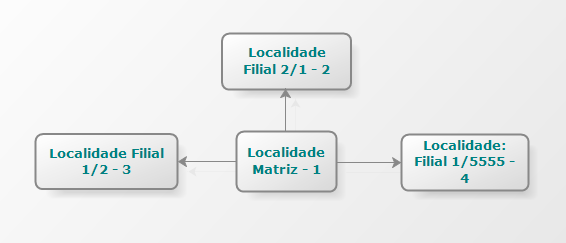
The first time when the Definition of Information Flow window is open by the user, after registering all locations, they will be displayed so that the configuration be defined. The initial status of each location will follow the default definition of replication, which does not impose restriction for sending information, that is, all workers from that location will be replicated as such, for all the other locations, according to the example in the image below:
Thus, to configure the Information Flow, the required locations for each location displayed on the window must be added. It must be noted that the default is to replicate workers for the other units.
Then, with location 1 selected, the user must click the Add button. A list of locations will be displayed, which have still not been included in the configuration, as shown in the image below:
As can be seen, the locations displayed are the ones registered and have still not been used to configure the information flow. Even the location 1 is displayed, which is the selected location.
For the purpose of explanation, we will define as RECIPIENT the location in which we are adding or removing localities and will define it as ADDED to a location that will be included or deleted in the RECIPIENT configuration. Thus, for each location that the definition of information flow is used, the system carries out the following checking:
If the ADDED is different from the RECIPIENT, it will be considered as receiving of replication of workers as workers from other units. That is, all workers registered in companies/branches represented by the RECIPIENT will be replicated as workers from Other Units for the location ADDED, according to the code of the server specified in it (R034FUN => R070OCR).
If the ADDED is the same location as the RECIPIENT, it means that the workers (R034FUN => R034FUN) represented by this location will not be replicated such as for the other registered locations.
If the RECIPIENT does not have a register indicating that the information flow stops in itself, the registers of workers will be replicated to the other locations which did not take part in the definition of information flow.
Let’s go back to the list of needs of the information flow previously presented and let’s select the first item of the list: The company 1/1 must replicate its workers as workers from other units for the companies 2/1 and 1/2. For the other companies (1/5555) the registers of workers will be replicated as such.
It means that the Location 2 and Location 3 will be added in the Location 1, so that the workers from Location 1 be replicated as Workers from Other Units for both locations. For Location 4, the workers from Location 1 will be replicated as Workers, not as Workers from Other Units. In case of replication of workers for Location 4 was not desired, it would be sufficient that the Location 1 was added in the Location 1. When adding the location in itself, it will prevent that the workers represented by this location be replicated such as for the other locations which did not take part in the definition of the information flow from Location 1.
Example of Definition of Information Workflow window, configured according to the customer need previously presented:
Legend:
- It represents the registered location.
- It represents the location that will receive workers as workers from other units.
- It reports that the workers from the location will be replicated as workers from other units.
- It reports that the workers from the location will not be replicated to another location, except the same.
Description: enter a name for the locale.
Server: Report to which server the location belongs.
Table of Holidays: Report the code of the table of holidays to which this location belongs. That is, when automatic processes of this location are run, it must be taken into consideration which is the table of holidays.
Data for Replication: Report the codes of companies and branches which will take part of this location.
 Veja também:
 English
 Español