
Salary Policy
After defining and configuring the job and salary tables structure, the policy criteria (organizational rules and decisions) involving remuneration processes for workers according to reasons such as framework, merit and promotions must be defined.
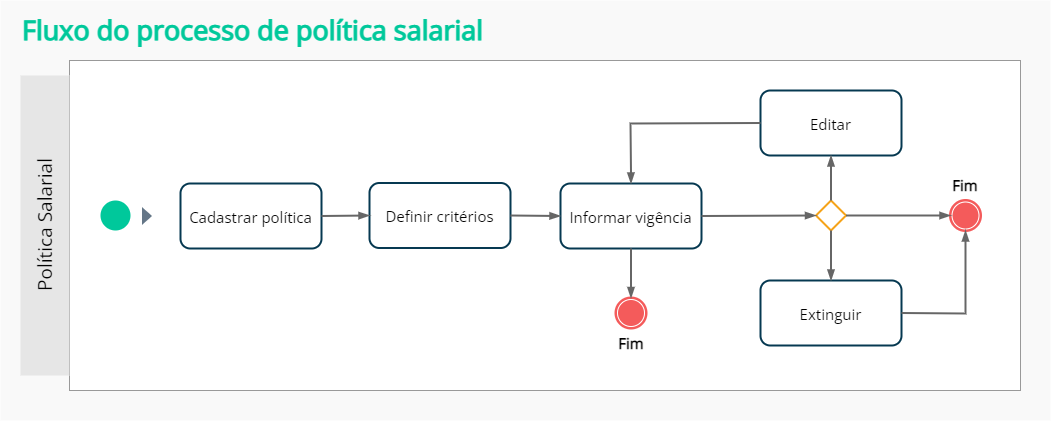
What can I do in the salary policy process?
Important
The functionalities of this screen will be available according to the user's permission.
 Register and manage a salary policy
Policy registration and management can be done at Compensation Management > Salary Policy > Manage Salary Policy. In this process, the HR department must take the following steps:
- Register a salary policy with the criteria applied for a given company/branch. It is possible to register the salary policy for more than one branch at the same time or for all branches, through the fieldBranch;
- Register the policy creator. The creator will always be the worker making the registration;
- Define the start of the policy validity;
- Register the reasons for the request;
- Register the policy criteria for each request reason. These criteria will be displayed when clicking the buttonDetail of each request reason. (A side menu with all the criteria will be presented.)
The salary policy management is done in the list, which can be filtered by current and extinct (no longer valid) policies. The list displays only revisions of the policies that are valid in the current date. If the policy only has future revisions, they will be displayed as well. The list is sorted alphabetically by policy name.
Policy registration fields
Creator
The Creator will be used in the policy history registers. The Worker who registered the policy criteria in the system is the one that will be displayed.
Policy criteria
Consist proposals above the job/position class?
Define whether a proposal can be made for a worker with the salary above the class of the job/position.
In case of a promotion, the job/position considered for the consistencies are the ones that were defined in the promotion proposal screen. For merit or framework cases, however, the job/position considered for the consistencies are the ones that have the current information of the worker. For cases in which the job and the job position have no salary information defined, the consistency is not executed.
The class and range are consisted, as well as the salary. The end class and range defined in the job/position salary information are considered, that is, the job position is considered first, and if it has no information, the job is considered. This information is compared to the class and range defined in the proposal.
The salary value is also considered. For this consistency, the salary value of the end class and range defined in the job/position salary information is considered. This information is compared to the salary value defined in the proposal.
Consist range limit?
Define whether there is a limit of ranges allowed for salary raises.
If the worker has no table, class and range information in his or her last salary, or if the compared tables are different, the consistency is not executed.
Consist percentage limit?
Define the maximum percentage allowed to be granted as a raise in proposals. The consistency considers the percentage value defined in the proposal and compares it to the percentage defined in the policy.
Consist time limit?
Defines the minimum time for salary movements for spontaneous reasons. The period between the date of the last spontaneous movement granted to the Employee and the date informed in the proposal is considered to be within the limit established in the policy for the type of request informed.
Important
Admissions will be considered as spontaneous movements, and will fit the rule ofconsist of time limit.
Consist results evaluation?
Define whether the Results Evaluation must be considered as a criterion for salary raises and what is the minimum percentage for this to happen.
The percentage of the worker's last results evaluation is compared to the percentage defined in the policy criterion. If the worker has no evaluations to be considered, the consistency is not executed.
Consist competence evaluation?
Define whether the Competence Evaluation must be considered as a criterion for salary raises and what is the minimum achievement concept for this to happen.
The concept of the worker's last competence evaluation is compared to the concept defined in the policy criterion. If the worker has no evaluations to be considered, the consistency is not executed.
Consist percentage limit below the initial limit?
Define the maximum salary raise percentage for workers with salaries below the initial class of the job/position.
If the worker's current salary is below the salary value of the initial class and range defined in the job/position, only the maximum percentage of this criterion is considered, and the percentage defined in the Consist percentage limit? criteria, What is the maximum raise percentage allowed? field is not considered.
In case of a promotion, the job/position considered for the consistencies are the ones that were defined in the promotion proposal screen. For merit or framework cases, however, the job/position considered for the consistencies are the ones that have the current information of the worker. For cases in which the job and the job position have no salary information defined, the consistency is not executed.
Consist time limit below the initial limit?
Define whether there is a time limit between salary raises for workers with salaries below the initial limit of the job level.
If the worker's current salary is below the salary value of the initial class and range defined in the job/position, the period that will be compared with the limit established in the policy is between the date of the last spontaneous raise granted to the Worker and date defined in the proposal.
In case of a promotion, the job/position considered for the consistencies are the ones that were defined in the promotion proposal screen. For merit or framework cases, however, the job/position considered for the consistencies are the ones that have the current information of the worker. For cases in which the job and the job position have no salary information defined, the consistency is not executed.
Consist a minimum period to execute the proposal?
Defines a minimum period, so that the execution of the salary proposal takes place from this period onwards. The consistency can be applied for proposals that are originated due to the framework, merit or promotion reasons, also including staggered proposals.
The period always begins from the current month onwards, but you can also choose the next month or the third month subsequent to the current one. For example, if the consistency is enabled on the current month of March, the minimum period will begin in March, the minimum deadline will begin in March (current month), but it can also begin in April (next month) or in May (the following month, after April), to establish the minimum period rule for the execution of proposals.
Upon filling out the Proposal Information screen, more precisely the What is the minimum date for the proposal execution? field, the defined date will be validated according to the minimum period rule, defined in the salary policy criteria screen.
Consist days allowed for tenders?
Defines the dates on which salary proposals can be opened and handled.
The suggested date must contain the first day informed in the configuration of the new criterion in the salary policy.
Consist closure date?
Defines the final date to approve, close or create a proposal in the month.
The rule considers the proposal request date and compares is to the date defined in this salary policy criterion.
Consist months allowed for proposal submissions?
Define in which months the submission of salary proposals is allowed.
The rule considers the month of the proposal request date and compares it to the months defined in this
For proposal staggerings, the rule is the same: the months selected in the staggering must be compatible with the months defined in the salary policy.
Consist annotation history?
Defines the types of notes that are considered disciplinary measures and the period corresponding to each of them, which can vary from 1 to 24 months. The annotations are obtained from the annotation records, registered in the Personnel Management module.
Disciplinary measures are registered in the Worker's annotation records and validated when a salary raise or promotion proposal is submitted.
Consist absenteeism?
Define the situations considered as absenteeism in a given period. The items that must be configured are:
- Situations: refers to the ones registered in the Time and Cafeteria Control module. They are shown in the salary policy field.
- Period: the considered period is between 1 and 12 months.
- Hours: defined by the salary policy.
The rule considers the sum of the Worker's absence hours and compares it to the absence hours of the situations considered as absenteeism by the salary policy, so that the salary raise and promotion proposals are consisted.
Rule fields for criteria
Alert and Block
When defining a rule that must be consisted during a salary raise or job proposal request, the Alert field indicates that something that was defined is out of the salary policy, although the request process can be carried on. The alert message is displayed for all process approvers.
The Block field indicates to the Manager that the information is out of the policy rules and the request process cannot proceed.
Edit the salary policy
The edit is made in the salary policy selected in the list screen. It is possible to edit the criteria fields. In the fieldBranch, you can add and remove branches to create new revisions.
Important
A policy revision cannot be created by associating branches that are already inserted in another policy which has a revision validity start on a future date, that is, after the date defined for the new policy revision. When trying to remove a branch from a policy which has a revision date after the defined date, it is necessary to modify the branch selection or change the date of the new revision.
When you save the modified data, the start date of the policy revision validity must be defined. This date cannot be earlier than other existing salary policy revisions, and the policy revision will be considered in effect from this date onwards.
When the revision is saved as the current policy, the end date of the previous one is filled in.
Extinguish the salary policy
Extinguishing the salary policy is defining a date on which it is no longer valid. This date will always be greater than the current date, and policies can also be extinguished on a scheduled date.
In the consultation screen, the date on which the policy was extinguished and the person responsible can be viewed. Previous revisions of the extinguished policy can be viewed as well, with the Validity period button.
 English
 Español