English
 Español

Irrigation
Irrigation is defined as the artificial application of water to the soil, at defined intervals and in sufficient quantity to provide plant species with water for their development.
This practice is extremely important for agriculture, as only 20% of the arable area is irrigated, but it is responsible for 40% of agricultural production. Irrigated agriculture is responsible for 70% of global freshwater capture, however, this use is consumptive, meaning the water does not return to the basin where it was captured.
These characteristics give irrigation the potential to increase agricultural production in a sustainable manner, without expanding the cultivated area, and to generate regional conflicts over water use. Therefore, irrigation management and proper management of water resources are fundamental to the success of the practice.
Motivation
The motivation to create an irrigation operations control system is to develop structures that allow the implementation of new features to control all aspects of irrigation. The solution already includes some of the planned features.
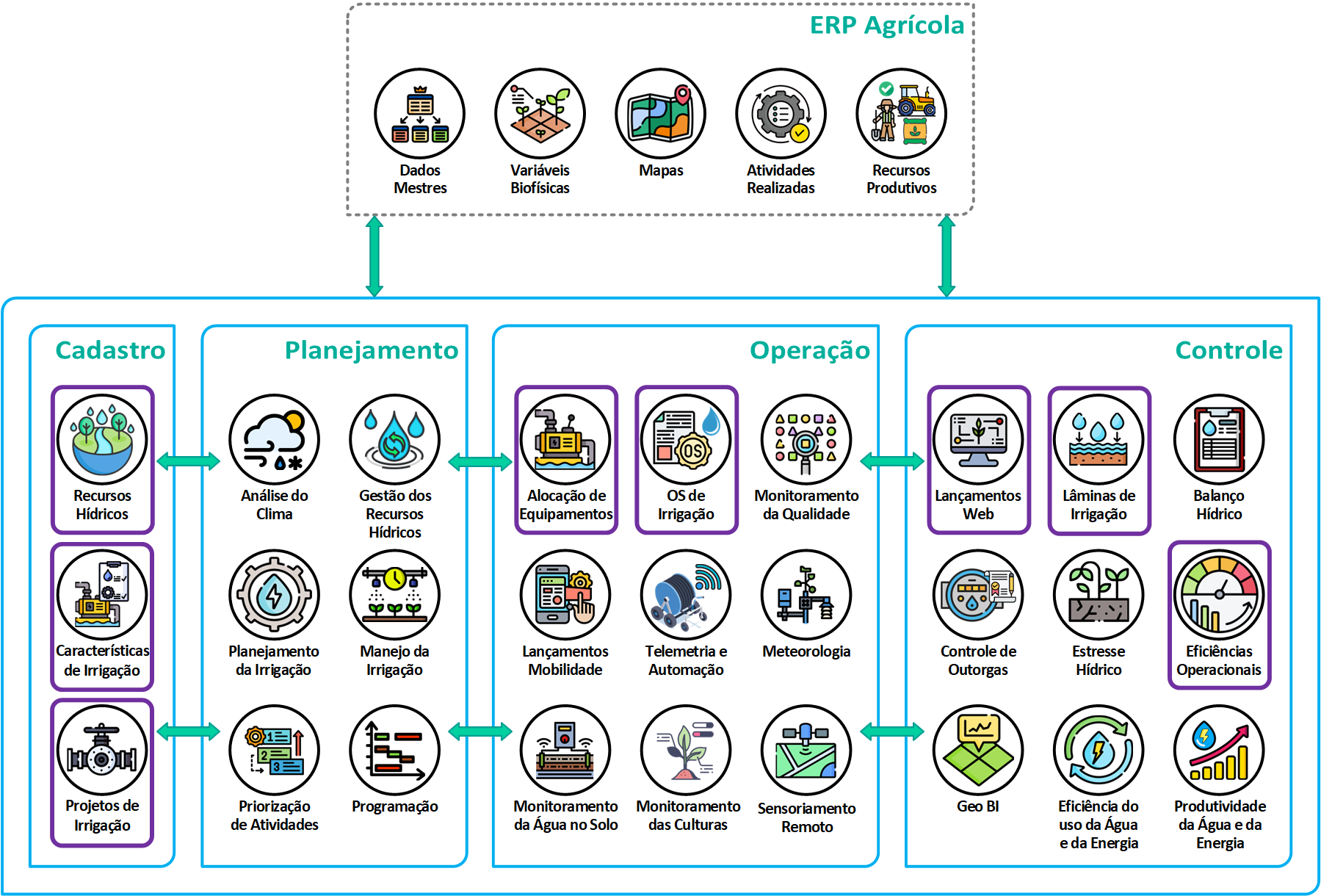
Among the planned features, the solution already includes those highlighted in purple in the figure.
Objective
The objectives of the irrigation control system include:
- Describe the relevant entities for irrigation and create structures to relate them, such as water resources, irrigation projects and equipment.
- Formalize the verbal command through irrigation service orders.
- Create interfaces to inform the operation, including hours and operation parameters of equipment and irrigated areas.
- Consist the movements in the system, ensuring the reliability of the information.
- Quantify the resources used and distribute their consumption among the locations, such as equipment operating hours, freshwater and wastewater volumes, and irrigation depths.
- Determine the efficiency of using these resources at different levels, such as irrigation projects, locations and equipment.
 English
 Español