English
 Español

Reports
The system has five reports that provide information about the quantities of resources consumed by irrigation, irrigated areas, water depths, and operation efficiency. Each of these extractions is described in the topics below:
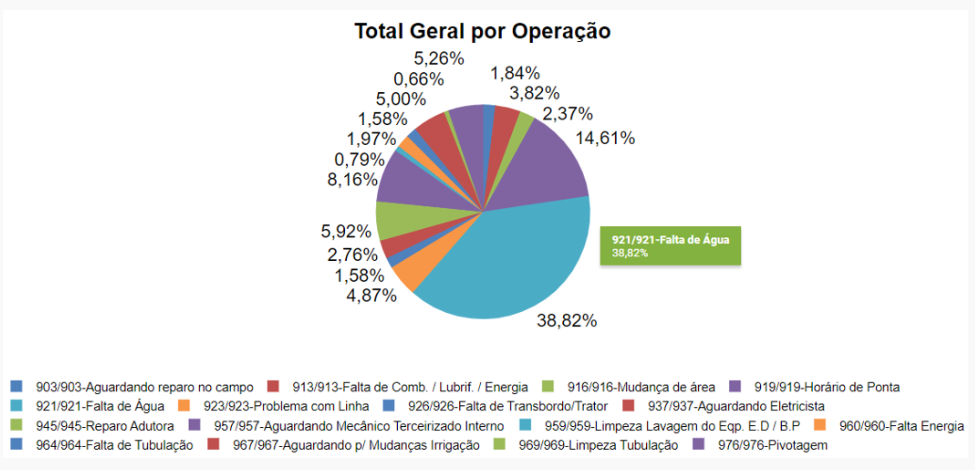
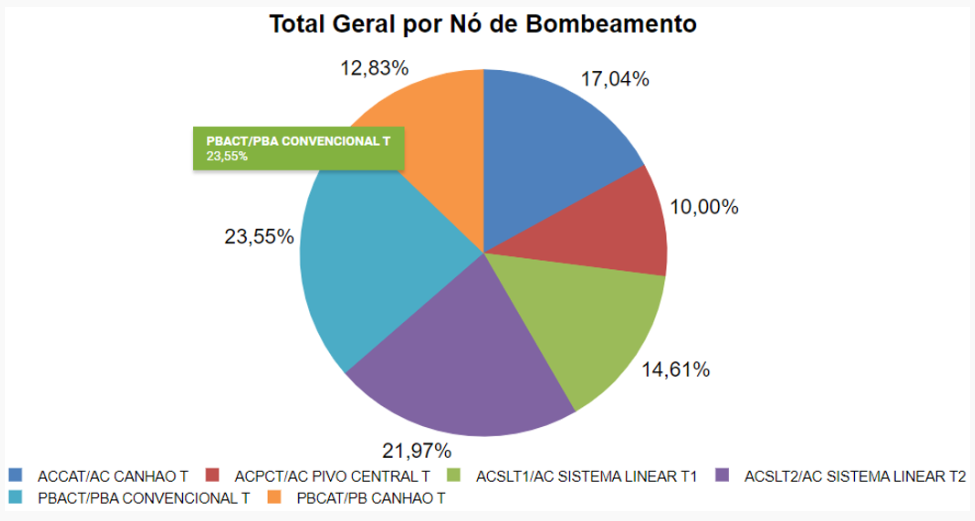
- This report presents the totalization of unproductive hours by operation, equipment, location in the tree, and irrigation project.
- The representativeness of each operation is calculated in relation to the total unproductive hours of the respective equipment.
- This same criterion is applied at higher levels, taking into account the representativeness of each equipment within a location, of each location within a project, and of each project within a production unit. The information can be filtered by date range, irrigation project, location, and equipment.
- This report presents the daily production of each equipment, including productive hours, volume produced, and operational efficiency indices. The data can be filtered by date range, irrigation project, location, and equipment type.
In this report we can evaluate the operation of each project daily through the variables:
- Launched area, ratio between the area of the irrigation work order and the number of launches;
- Irrigated area, sum of the area generated by irrigation reports;
- Overlap, ratio between the irrigated area and the launched area;
- Productive hours, sum of productive hours from the reports;
- Potassium oxide, sum of the mass of K₂O, in kilograms, generated by the application of vinasse;
- Attendance, ratio between the number of men in the report and the product between the operation days and number of operation days;
- Overall operation efficiency;
This information can be filtered by a date range, irrigation project, irrigation type, and item.
In this report, the entries made for mobile irrigation are consolidated by agricultural locations and irrigation projects, bringing:
- Topographic area, corresponds to the cadastral area of the agricultural location;
- Irrigated area, sum of the areas generated by the reports;
- Applied area, sum of the areas applied in the irrigation service order;
- Overlap, ratio between irrigated area and applied areas;
- Irrigated volume, sum of the volumes generated by the reports;
- Depth, ratio between the irrigated volume and the topographic area;
- Number of depths, ratio between the applied areas and the topographic area;
- Productive time, sum of the productive times generated by the reports;
- Start date, date of the first report for the location;
- End date, date of the last report for the location;
- Last item, last item reported for the location;
This information can be filtered by a date range, irrigation project, irrigation type and item.
In this report, the entries made for fixed irrigation are consolidated by agricultural locations, sectors, command areas and irrigation projects, bringing:
- Volume, sum of the volumes generated by the reports;
- Topographic area, corresponds to the cadastral area of the agricultural location;
- Depth, ratio between the irrigated volume and the topographic area;
- Irrigated area, area of the agricultural location irrigated by the sector;
- Sector depth, ratio between the irrigated area and the volume;
- Start date, date of the first report;
- End date, date of the last report;
This information can be filtered by a date range and by irrigation project.
 English
 Español